Table of Contents
Gypsum vs grid false ceiling — this is one of the most common specification decisions architects face on commercial fit-out projects. The wrong choice can mean cost overruns, maintenance headaches for the client, or a ceiling that looks nothing like the rendered concept once it’s executed on site.
This guide breaks down both systems — where each performs best, what they cost, and how execution quality changes the outcome regardless of which one you specify.
What Is a Gypsum False Ceiling?
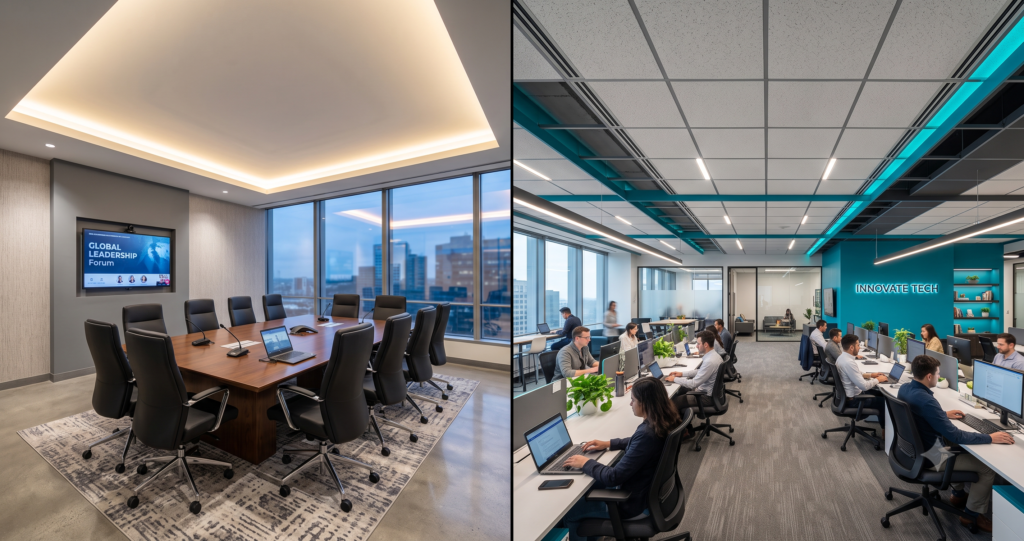
A gypsum false ceiling is built from gypsum boards fixed to a metal frame, then jointed, taped, and finished to create a seamless, monolithic surface. Because the final surface has no visible grid lines, it gives architects full freedom over form — coves, steps, curves, cutouts for lighting, and integrated AC diffusers can all be built into the design.
Gypsum ceilings are the default choice when the design brief calls for a clean, uninterrupted ceiling plane or when the ceiling itself is a design feature — reception areas, boardrooms, and lobby spaces typically use gypsum for this reason.
What Is a Grid False Ceiling?
A grid false ceiling uses a suspended metal grid (T-grid or concealed grid) into which standard-sized tiles — mineral fiber, gypsum, or metal — are laid or clipped. The grid remains visible in most configurations, giving the ceiling a modular, uniform appearance.
Grid systems are the standard specification for spaces where serviceability matters more than form — server rooms, back-of-house areas, open-plan floors with heavy MEP density above the ceiling, and any space where tiles may need to be lifted repeatedly for maintenance access
Gypsum vs Grid False Ceiling: Side-by-Side Comparison
| Factor | Gypsum False Ceiling | Grid False Ceiling |
| Design flexibility | High — coves, steps, curves, cutouts | Low — flat, modular grid pattern |
| Execution time | Longer — multiple site-finishing stages | Faster — prefabricated tiles, quicker install |
| Cost per sq. ft. | Higher (finishing, jointing, painting) | Lower (standardized tiles, less labor) |
| Access to services above ceiling | Difficult — requires cutting and patching | Easy — tiles lift out individually |
| Best suited for | Reception, boardrooms, lobbies, feature zones | Server rooms, back-office, high-MEP-density floors |
| Maintenance | Repairs visible unless redone by a skilled team | Tile replacement is simple and low-cost |
| Acoustic performance | Depends on added acoustic treatment | Acoustic tiles readily available off-the-shelf |
When Architects Should Specify Gypsum
Specify gypsum when the ceiling is part of the design language of the space. If your drawings show coved transitions, recessed cove lighting, stepped levels around a boardroom table, or a seamless plane leading into a feature wall, gypsum is the only system that can deliver it. It’s also the right call in spaces where the client has said the ceiling should “disappear” — a flat, paint-finished gypsum surface reads as more premium in corporate reception and leadership-floor design than a visible grid.
The trade-off architects need to flag to clients upfront: gypsum ceilings are harder and more expensive to open up later. If the MEP layout above the ceiling isn’t finalized, or if the client anticipates frequent reconfiguration, gypsum adds risk.
When Architects Should Specify Grid
Specify grid where access matters more than appearance — IT rooms, plant rooms, pantries, back-office zones, and any floor with dense cabling, HVAC ducting, or sprinkler heads that facility teams will need to reach regularly. Grid is also the pragmatic choice on tight execution timelines, since tile-and-grid installation moves faster than multi-stage gypsum finishing.
Many commercial projects in Hyderabad use a hybrid approach — gypsum in client-facing zones (reception, boardrooms, cabins) and grid in operational zones (open floor, server room, pantry) — which balances design intent with long-term maintainability across the full floor plate.
Why Execution Quality Matters More Than the Choice Itself
Specifying the right system on paper is only half the outcome. Both gypsum and grid ceilings are execution-sensitive:
- Gypsum depends entirely on jointing and finishing quality. Poor taping shows as visible seams and cracks within months, especially where the substrate hasn’t cured properly.
- Grid depends on level accuracy across the suspension system. An uneven grid is immediately visible and hard to correct once ceiling-mounted fixtures (lights, diffusers, sprinklers) are installed.
This is why architects increasingly brief a dedicated execution partner rather than leaving ceiling work to a general fit-out contractor. A team that specializes in ceiling execution catches coordination clashes with electrical, HVAC, and fire-fighting layouts before installation — not after the tiles or gypsum board are already up.
Frequently Asked Questions
Is gypsum or grid false ceiling cheaper for commercial office fit-outs?
Grid false ceiling is typically cheaper per square foot because tiles are prefabricated and installation is faster, with less site labor for finishing. Gypsum costs more due to jointing, sanding, and painting stages.
Can gypsum and grid ceilings be combined in the same floor?
Yes. A hybrid layout — gypsum in reception, boardrooms, and cabins, grid in open floor and back-of-house zones — is common in Hyderabad commercial projects and balances design intent with maintenance access.
Which false ceiling type is better for acoustics?
Grid systems have a wider range of off-the-shelf acoustic tiles available. Gypsum can match or exceed acoustic performance but requires additional acoustic insulation layered above the board, adding cost and design coordination.
How long does false ceiling execution typically take on a commercial floor?
Grid ceiling installation is generally faster since tiles are prefabricated. Gypsum ceiling work takes longer due to multi-stage site finishing — framing, boarding, jointing, sanding, and painting — each of which needs curing time before the next stage begins.
Get It Executed Right, Not Just Specified Right
Focal Spaces executes both gypsum and grid false ceiling systems for commercial and infrastructure projects across Hyderabad — including acoustic, decorative, and customized ceiling work. If you’re an architect specifying ceiling systems for an upcoming project, we can walk your team through execution feasibility before drawings are finalized.
Get in touch with Focal Spaces to discuss your ceiling execution requirements.