
| A plumbing crew finishes rough-in. A tiling team arrives two days later, skipping the waterproofing cure window because the schedule is tight. Six months after handover, the client calls—seepage has damaged the bedroom wall, tiles are cracking along the bathroom edge, and the floor adhesive is coming apart. |
The contractor did not use bad tiles. The waterproofing was not substandard. The sequence was wrong — and that single error compounded through every phase that followed it.
This is the most under-discussed failure mode in the interior fit-out industry. Everyone talks about material quality, vendor selection, and design intent. Very few talk about the dependency chain that governs when each trade must arrive, what must be complete before they start, and what they must leave finished before the next phase begins.
In our work executing premium residential and commercial fit-out projects across Hyderabad, the majority of costly rework situations we are called in to assess trace back to a single root cause: the execution sequence was treated as a loose suggestion rather than a load-bearing structure.
This post breaks down the five most expensive sequencing mistakes we see on-site, explains the compounding cost logic behind them, and shows what the correct execution order looks like—drawing directly from our 24-step residential site execution methodology.
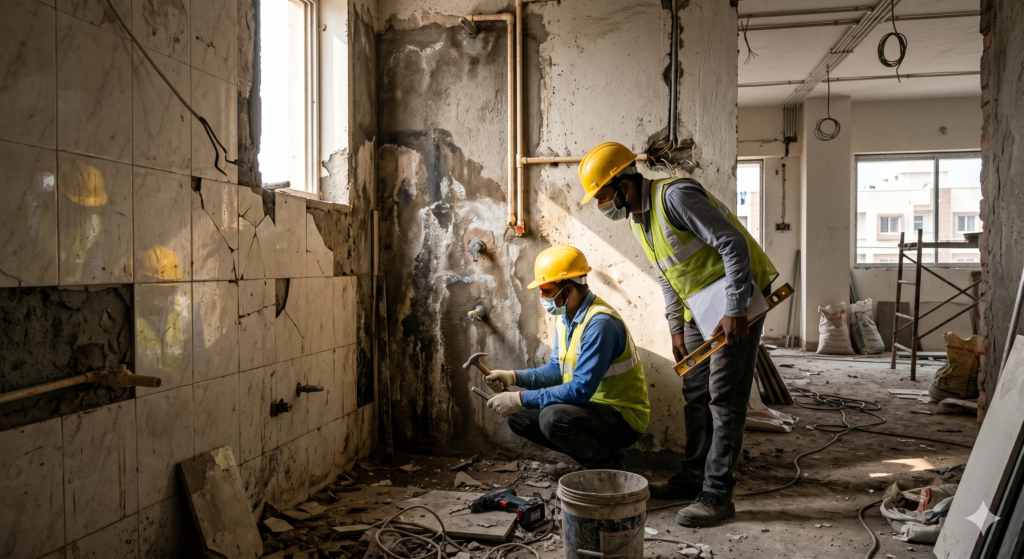
What is site sequencing — and why does it govern everything?
Site sequencing is the deliberate order in which each trade and phase of work is executed on a fit-out or construction site. It is not a project schedule. It is a phase dependency map — a chain of cause and effect where every phase creates the physical conditions that the next phase depends on.
Think of it as structural engineering for the execution process itself. Just as a structural engineer calculates load paths through a building, a project manager must calculate the dependency path through the work sequence. When the load path is compromised, the building fails. When the dependency path is violated, the project fails.
| The Focal Spaces 24-step framework is built around this exact dependency logic—each of the 24 steps is sequenced to create the right substrate conditions for the step that follows it. Internal link: focal spaces. in/blog/24-step-residential-site-execution-methodology |
When these dependencies are respected, a project runs on time, rework is minimal, and the finished quality reflects what was designed. When they are violated — even once, even partially — the failures cascade in ways that are expensive, time-consuming, and often invisible until months after handover.
The 5 most costly site sequencing mistakes on interior projects
| MISTAKE 01: 01 Tiling before waterproofing is fully cured |
| What happens on site: Waterproofing is applied in toilets and wet areas. The schedule is already running tight, so the tiling crew arrives within 24–36 hours of the waterproofing coat. The membrane appears dry to the touch, so work proceeds. The adhesive is laid directly over a membrane that has not completed its chemical cure cycle. The bond between the adhesive, membrane, and substrate is compromised from day one—but it will not show for months, sometimes not until after the monsoon cycle stresses the structure. What the client sees: Tiles crack along grout lines. Edges begin to lift. Seepage appears on the wall adjacent to the bathroom — sometimes in the bedroom, sometimes in the room below. A full tile removal, structural inspection, re-waterproofing, and re-tiling is required. Rework cost: 2–3× original tiling cost Correct sequence: Step 11 · Waterproofing → Pond test → 72 hr cure → Step 14 · Tiling begins |
| MISTAKE 02 False ceiling boards fixed before electrical cabling is pulled |
| What happens on site: The GI framework is installed, and gypsum boards are fixed and jointed before the electrician has pulled the circuit cables through the conduits. This is one of the most common sequencing violations in fast-tracked residential projects. When the electrician arrives to pull cables, the conduits are now sealed behind boards. The crew must either route cables externally along visible surfaces or cut into the POP work to access the conduits—destroying the surface finish in the process. What the client sees: Visible cable runs, patchy POP repairs, and repainting of affected ceilings across multiple rooms. On smart home projects, the automation wiring is often left partially incomplete because reopening the ceiling is deemed too expensive. Rework cost: ₹40,000–₹1,20,000 per floorCorrect sequence: Step 07 · Conduit laying → Step 08 · GI framework → Step 10 · Cabling pull → Step 09 · POP boarding |
| MISTAKE 03 Carpentry framing before AC drain lines are routed |
| What happens on site: Carpentry for wardrobes, media units, and wall paneling begins before the HVAC team has routed the insulated copper refrigerant piping and drain lines to each AC point. The carpentry framework is built tight to the walls, leaving no route for the drain line penetrations. When the AC team arrives, they find their routing path blocked. Drain lines either need to be exposed on the surface or the carpentry must be partially dismantled to create penetrations—causing surface damage and finish inconsistencies on newly built units. What the client sees: visible drain piping running along finished wall panels or carpentry that has been cut and repaired—neither of which reflects the quality standard of a premium fit-out. Rework cost: ₹25,000–₹80,000 + AC commissioning delay Correct sequence: Step 13 · AC piping & drain routing → Step 15 · Carpentry framing begins |
| MISTAKE 04: Wall painting before electrical finishing is complete |
| What happens on site: Final paint coats are applied to achieve handover-ready wall surfaces. The electrical team then arrives to mount modular switches, sockets, and automation touch panels—cutting fresh paint edges, marking the wall surface with tools, and leaving chipped or scuffed patches around every installation point. This happens more often than most contractors will admit, particularly when painting and electrical finishing are managed by different vendors with independent delivery timelines that have not been coordinated through a central execution manager. What the client sees: Chipped paint edges around every switch and socket. Tool marks. Mismatched touch-up patches on premium emulsion finishes—often across every room in the flat. Rework cost: Full repaint of affected walls in 3–4 rooms Correct sequence: Step 19 · Electrical finishing → Step 20 · Lighting installation → Step 21 · Final paint coats |
| MISTAKE 05: Floor polishing before carpentry and decor snagging |
| What happens on site: Marble or vitrified floors are polished to handover-ready condition. The carpentry snagging team then arrives to fit edge bands, profile glass shutters, soft-close dampers, and premium handles—dragging equipment across the polished surface, dropping hardware, and placing tool bags and component boxes directly on the floor. A polished marble floor that has been through a final carpentry snagging session without protective covering will require re-polishing. Diamond mirror-polish cycles are not inexpensive, and on natural marble, re-polishing can alter the surface character in ways that are difficult to match.What the client sees: Scratches, haze marks, and dulled areas on the floor they were handed at the walkthrough. A re-polishing appointment that delays their move-in. Rework cost: ₹30,000–₹100,000 depending on floor area and material Correct sequence: Step 23 · Carpentry finishing → Step 24 · Decor snagging → Step 22 · Floor polish & deep clean |
Why one wrong step multiplies into a project crisis
What makes sequencing failures especially damaging is that they rarely stay isolated. A single out-of-sequence decision triggers a cascade that touches every phase downstream.
Consider a typical cascade on a premium 3 BHK in Hyderabad—a project where tiling begins before waterproofing cure:
- Tiling laid on uncured waterproofing → adhesive bond compromised from day one
- Waterproofing failure discovered post-monsoon → full bathroom demolition required
- Bathroom demolition → AC drain line in adjacent wall disturbed
- AC drain line disturbance → carpentry in that room must be partially opened
- Carpentry open → painting rework across bathroom-adjacent walls
- Painting rework → floor protection re-laid, polishing deferred again
- Total delay: 4–6 weeks post-handover. Client in temporary accommodation.
Real-Cost Impact · Premium 3 BHK · Hyderabad
₹1.5L – ₹4LEstimated rework costs range from a single sequencing failure—a tiling job that began before the waterproofing cure window. This excludes client compensation, temporary accommodation costs, and the unmeasurable cost of referral loss.
| “Site sequencing is the invisible architecture of an interior project. You cannot see it in the renders, you cannot read it in the BOQ — but it is the single structure that everything else is built on.” |
The financial damage is significant. The reputational damage—for the architect who specified the project, the interior designer who is associated with the fit-out, and the contractor who executed it—is often far more costly in the long run.
What to look for in a B2B execution partner who gets sequencing right
For architects, interior designers, and builders evaluating fit-out execution partners, sequencing discipline is one of the hardest things to assess from a proposal deck. Here are the questions that actually surface it:
Can they provide a reference from a completed B2B project? Not a homeowner testimonial — a reference from an architect, designer, or builder who has worked with them across multiple projects.
Do they have a written execution methodology? Not a verbal process, not a WhatsApp checklist — a documented, version-controlled phase dependency map that can be reviewed before a site begins.
Do they conduct a pre-execution site audit? A serious execution partner identifies sequencing conflicts before trades arrive — not after damage has been done. Ask specifically about their pre-execution audit process and what it covers.
Is there a dedicated project manager on site — or just a vendor coordinator? Coordinating vendors and managing a phase dependency chain are different jobs. One person taking calls from five subcontractors is not site management; it is reactive firefighting.
Do they conduct phase-completion checks before the next phase begins? Ask how they sign off on waterproofing before tiling starts, or how they confirm cabling is pulled before POP boards go up. If there is no answer, there is no process.
At Focal Spaces, our Aapka Project Manager model places a dedicated execution manager on every site—accountable for the full phase dependency chain from Step 01 (site survey) to Step 24 (handover audit). The entire process is governed by our 24-step execution methodology (v2.4). Interior designers and architects working with us retain full design control; we take accountability for how that design reaches the site.
For builders and turnkey contractors looking to scale delivery without adding headcount, a B2B execution partner with a proven sequencing methodology is the structural solution — not more subcontractors, and not more coordination overhead on the principal’s side.
Frequently asked questions
| What is the correct sequence for interior fit-out work? |
| The correct sequence begins with civil and demolition work, followed by plumbing rough-in, electrical conduit laying, false ceiling framework, waterproofing, wall preparation, tiling and flooring, carpentry framework, kitchen installation, electrical finishing, lighting, and finally painting, polishing, and snagging. Each phase must be inspected and signed off before the next begins. Skipping or compressing any phase creates the substrate conditions for failure in the phase that follows it. |
| What causes bathroom tiles to crack or fail after installation? |
| The most common cause is tiling before waterproofing has fully cured. Adhesive bonds laid on uncured waterproofing membranes fail within 6–12 months, causing tiles to delaminate, crack, and allow seepage into adjacent rooms. The fix — full tile removal, structural inspection, re-waterproofing, and re-tiling — typically costs 2–3× the original tiling work. A minimum cure period of 72 hours (confirmed by a pond test) must be completed before tiling begins. |
| How do I avoid rework costs in a premium residential interior project? |
| The single most effective way is to enforce a phase dependency map before any trade arrives on site. A pre-execution site audit identifies sequencing conflicts before they become rework. Engaging a dedicated B2B execution partner with a written execution methodology — rather than coordinating individual vendors yourself — removes sequencing risk from the project. Ask specifically whether your execution partner has a documented phase sign-off process for each step. |
| What does a B2B interior execution partner do differently from a subcontractor? |
| A B2B execution partner takes accountability for the entire site execution sequence — coordinating all trades in the correct phase order, conducting QC checks between phases, and maintaining a single point of responsibility from pre-execution audit to client handover. A subcontractor is accountable only for their own trade scope and has no visibility or control over phase dependencies. When something goes wrong at the intersection of two trades, there is no subcontractor responsible for that interface — there is only the project manager who should have been managing it. |
Is your next project at risk from poor site sequencing?
Our team at Focal Spaces conducts a free pre-execution site audit for architects, interior designers, and turnkey contractors across Hyderabad. We identify sequencing risks before they become rework costs.
Book Your Free Site Audit
About the author
Focal Spaces Execution Team
B2B Interior Fit-Out Execution · HyderabadThe Focal Spaces execution team has delivered premium residential and commercial interior fit-out projects across Hyderabad, managing end-to-end site execution for architects, interior designers, and turnkey contractors. Our 24-step methodology is built on over a decade of phase-dependency management across 3 BHK, villa, and commercial interior projects in Telangana and Andhra Pradesh.