
Every corporate company, IT office, startup, and builder that undertakes an interior fit-out project in Hyderabad faces the same fundamental question: should we manage this in-house, or should we hand it to a specialist B2B execution partner?
The in-house vs B2B interior execution decision is more consequential than most teams realize. It determines not just how the project is managed but also whether it is delivered on time, within budget, and at the quality standard the business needs. And it determines how much of your core team’s time, attention, and energy is consumed by a construction project that is not your core business.
This guide breaks down the real differences between in-house interior execution management and working with a B2B execution partner—covering supervision, cost control, accountability, timelines, and the hidden costs that most in-house managed projects accumulate before anyone notices.
Understanding why interior projects fail on site is a useful starting point—most of the seven failure modes described there are significantly more likely in in-house managed projects than in B2B-executed ones
The question is not whether in-house management can work. It can — in the right circumstances. The question is whether the circumstances of your project match the conditions that make in-house management viable. For most commercial interior projects in Hyderabad, they do not.
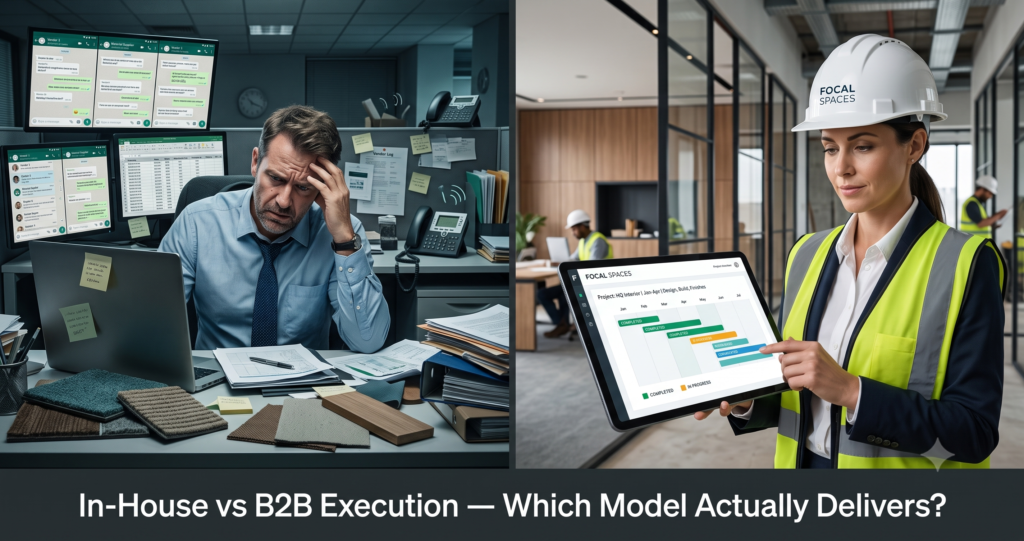
What ‘In-House Interior Execution Management’ Actually Means
In-house interior execution management means the client — whether a corporate tenant, a builder, or a developer — directly manages all the trades involved in the fit-out. This typically involves:
- Identifying, shortlisting, and negotiating with 6–12 individual trade contractors (civil, false ceiling, electrical, HVAC, plumbing, flooring, painting, joinery, IT cabling, fire systems, AV, signage)
- Coordinating the sequence of trades — deciding who comes on site in what order, and managing the handoffs between them
- Monitoring quality on site — either personally or through an existing staff member who is also managing their core responsibilities
- Managing material procurement — following up on deliveries, handling shortages, approving substitutions
- Resolving conflicts between trades — when the electrician’s conduit clashes with the AC duct, someone has to decide
- Handling variations and cost changes — approving changes verbally, managing informal cost tracking
- Driving the project to completion — chasing contractors who are slow, resolving defects, managing the handover
This is a significant programme management task. For a 5,000 sq ft commercial fit-out, it consumes approximately 15–25 hours per week of someone’s time for 12–18 weeks. That person is usually the operations manager, the admin head, or the business owner — none of whom have site management or interior execution expertise.
⚠️ In-house management is not free. The hidden cost of internal staff time, distraction from core business, and the inevitable cost of coordination errors is routinely 20–30% of the construction contract value — and it never appears on a project budget.
What a B2B Interior Execution Partner Actually Does
A B2B interior execution partner takes single-point accountability for the full fit-out from mobilisation to handover. The client’s involvement is limited to: approving the design, approving the BOQ-based contract, making milestone payments, and accepting the completed space at handover.
What the execution partner manages on behalf of the client:
- All trade contractor selection, negotiation, and management — the client deals with one party, not twelve
- A dedicated, qualified site supervisor present on site every working day
- MEP coordination drawings produced before any above-ceiling work begins — eliminating the most common source of rework
- A written, milestone-based site programme with agreed dates for every major activity
- BOQ-based pricing with full itemisation — no surprises at handover
- Formal variation order process — all scope changes documented, priced, and approved before proceeding
- Structured daily site reports with photographic documentation sent to the client
- Formal snagging inspection before handover — written list, rectification period, client sign-off
- As-built drawings delivered at handover
- 12-month defect liability period covering all trade workmanship
The client’s role becomes strategic and approvals-based — not operational and reactive. This is the fundamental difference between the two models.
In-House vs B2B Interior Execution: Full Comparison
| Criteria | In-House Management | B2B Execution Partner |
| Project supervision | Operations/admin staff managing trades — not their core skill | Dedicated qualified site supervisor daily on site |
| Accountability | Distributed — no single point of failure or ownership | Single partner accountable for full scope and quality |
| MEP coordination | Each trade coordinates individually — conflicts common | Execution partner coordinates all trades with drawings |
| Vendor management | Company manages 6–10 vendors simultaneously | Single contract, single point of contact |
| Cost visibility | Costs emerge as project progresses — surprises common | BOQ-based pricing — full cost locked before start |
| Design changes | Informal verbal approvals — no variation control | Formal variation order process — cost declared upfront |
| Site reporting | Informal WhatsApp updates to internal team | Structured daily reports with photo documentation |
| Quality control | No formal snagging — issues discovered after occupation | Formal snagging inspection before every handover |
| Timeline adherence | No milestone-based programme — dates slip easily | Written milestone programme agreed at contract stage |
| Defect liability | Individual vendors — difficult to enforce post-handover | Single DLP clause covering all trades for 12 months |
| Core business impact | Operations team distracted from core work for months | Zero distraction — execution fully managed externally |
| Scalability | Difficult to scale across multiple projects simultaneously | Same system works for 1 or 10 projects in parallel |
| Typical cost overrun | 20–40% above initial estimate | 5–10% variance with BOQ-based contract |
The Real Cost Comparison: What In-House Management Actually Costs
The most common argument for in-house interior execution management is cost — the assumption that cutting out a B2B execution partner saves money. This assumption is almost always wrong when the full cost of in-house management is calculated.
| Cost Item | In-House Management | B2B Execution Partner |
| Construction cost | Market rate — same for both models | Market rate — same for both models |
| Internal management time | Operations staff: 15–25 hrs/week for 12–20 weeks = Rs. 2–5L hidden cost | Zero — fully managed externally |
| Rework from poor coordination | Rs. 3–12L typical on a 5,000 sq ft project | Minimal — coordination drawings prevent rework |
| Variation cost surprises | 15–25% above initial estimate common | Formal VOs — changes priced before proceeding |
| Delay cost (rent, lost productivity) | Rs. 1–4L per week of overrun | Milestone programme reduces overrun risk significantly |
| Post-handover defect remediation | Rs. 2–8L — no DLP enforcement | Covered under 12-month DLP at no additional cost |
| Total real project cost | Often 30–45% above initial quote | Typically 5–12% above BOQ — predictable and controlled |
For detailed construction cost benchmarks, see our guide to interior fit-out cost in Hyderabad — which covers actual 2026 price ranges across specification levels.
The B2B execution partner’s fee — typically 8–12% of the construction contract value — is almost always recovered through better cost control, elimination of rework, and reduced delay costs. On a Rs. 1 crore project, the fee is Rs. 8–12 lakhs. The typical hidden cost of in-house managed projects of the same size is Rs. 20–45 lakhs.
5 Specific Problems In-House Management Creates — and How B2B Solves Them
1. No one is on site every day
In-house managed projects in Hyderabad are almost universally supervised remotely — the operations manager visits once or twice a week and relies on WhatsApp photos in between. In that time, incorrect ceiling grid heights get covered, misaligned partitions get plastered, and first-fix electrical work gets buried in walls before anyone checks it.
B2B solution: A dedicated site supervisor is present every working day. Their entire responsibility is quality and sequence compliance. Problems are caught and corrected on the day they occur — not weeks later when they are expensive to fix.
2. MEP conflicts discovered after ceiling closure
Without a coordination drawing, the AC contractor, the electrician, and the fire suppression team all work independently above the ceiling. When they conflict — which they always do — the ceiling must be opened, trades revisited, and work redone. This adds 2–4 weeks and Rs. 3–8 lakhs to a typical 5,000 sq ft project.
B2B solution: MEP coordination drawings are produced and approved before any above-ceiling work begins. Every pipe, conduit, and duct has an agreed position. The ceiling closes once — and stays closed.
3. Scope changes with no cost control
In in-house managed projects, design changes happen informally. A WhatsApp message to the contractor, a verbal instruction on site, a change of mind about a material. Each change adds cost. None of it is tracked. At handover, the contractor presents a final invoice that is 20–35% above the original quote — and the client has no documented basis to dispute it.
B2B solution: Every scope change goes through a formal variation order — documented, priced, and approved before the contractor proceeds. The client always knows the cost of a change before it is made.
4. Vendor accountability gaps at handover
When a defect appears six months after handover in an in-house managed project, the client must identify which of their 10 trade contractors is responsible, track them down, convince them to return, and manage the remediation — all while running their core business. In practice, most defects in in-house managed projects are simply absorbed by the client.
B2B solution: A single 12-month defect liability period covers all trade workmanship under one contract. One call to one partner resolves any defect — no vendor-chasing required.
5. Core business disruption
The most underestimated cost of in-house interior execution management is what it does to the people managing it. An operations manager who spends 20 hours a week managing a fit-out project for four months is not available for their actual job for those four months. The strategic cost of that distraction — in delayed decisions, unattended processes, and reduced team performance — frequently exceeds the direct project cost savings.
B2B solution: The execution partner manages the project. The client’s team manages the business. Both do what they do best.
When to Choose Each Model: A Decision Guide
The right model depends on your specific situation. Use this table to identify which approach fits your project.
| Your Situation | Recommended Model |
| First office fit-out, no prior project experience | B2B Execution Partner — structured process protects you |
| Multiple simultaneous projects across locations | B2B Execution Partner — scales without adding internal headcount |
| Core team has active project management bandwidth | In-House possible — but only with experienced PM and full-time supervisor |
| Tight timeline with penalty clauses for overrun | B2B Execution Partner — milestone programme is non-negotiable |
| Premium specification with imported materials and AV | B2B Execution Partner — specialist procurement and coordination required |
| Simple, small renovation under Rs. 10 lakhs | In-House manageable — low complexity, few trades involved |
| High-value corporate headquarters or client-facing space | B2B Execution Partner — quality, brand, and timeline cannot be risked |
| Repeat projects with a trusted contractor network already in place | In-House possible — if contractor accountability systems are solid |
If you decide to work with a B2B execution partner, read our guide on how to evaluate an execution contractor before making a selection — including a 10-point scorecard to compare partners objectively.
Also refer to the outsourcing principles that apply to any specialised function — interior execution follows the same logic: outsource what is not core, retain what is
How Focal Spaces Works as Your B2B Execution Partner
Focal Spaces is a B2B interior execution partner working with corporate companies, IT offices, startups, architects, builders, and real estate developers across Hyderabad. We take single-point accountability for commercial and residential fit-out projects from mobilisation to handover — so your team can focus on your business, not on managing construction.
Every project we execute includes:
- BOQ-based pricing with full scope itemisation — no surprises
- Dedicated site supervisor present daily on every project
- MEP coordination drawings before any ceiling work begins
- Milestone-based written site programme
- Structured daily site reports with photographic documentation
- Formal snagging and as-built drawings at handover
- 12-month defect liability period as standard
To understand how we work and what makes us different, visit our B2B interior execution partner in Hyderabad page, or contact our team to discuss your next project.
Frequently Asked Questions
Is in-house interior execution management always more expensive than using a B2B partner?
Not always — but it almost always is when the full cost is calculated. The construction contract value is identical in both models — you pay the same trade contractors either way. What changes is the hidden cost: internal staff time, coordination errors, rework, variation surprises, and delay costs. On projects above Rs. 30 lakhs, these hidden costs almost always exceed the B2B partner’s fee.
What size of project justifies a B2B execution partner?
As a general guideline, any commercial fit-out above Rs. 25–30 lakhs benefits from a B2B execution partner. Below that threshold, the fee may not be economical for a simple project. However, complexity matters more than cost — a Rs. 20 lakh project with multiple trades, a tight timeline, or a premium specification may benefit from a B2B partner even if the contract value alone does not obviously justify it.
Can we use a B2B execution partner alongside our own architect or interior designer?
Yes — and this is the most common B2B model in Hyderabad. The architect or interior designer handles the design, drawings, and specification. The B2B execution partner takes the GFC drawings and executes the fit-out. The two work in parallel — design and execution — with the execution partner raising formal RFIs when site conditions require design clarification. This separation of responsibilities produces the best outcomes.
How do we maintain visibility over the project if the execution partner is managing it?
Visibility is maintained through structured reporting, not direct management. A well-run B2B execution partner provides daily site reports with photographs, a live milestone tracker against the agreed programme, and a formal variation order process that requires client approval before any scope changes proceed. You know exactly what is happening on site every day — without having to be there.
Does using a B2B execution partner mean we lose control of the project?
No — it means you shift from operational control (managing day-to-day site activities) to strategic control (approving scope, budget, and milestone decisions). You retain full authority over design choices, scope changes, and payment milestones. What you give up is the time and stress of coordinating trades, chasing deliveries, and resolving on-site conflicts — all of which are better handled by specialists.
Summary
The in-house vs B2B interior execution decision comes down to one question: what is your core competency, and do you want your team spending months of their capacity on something outside it?
In-house management can work for simple, low-value projects where your team has the bandwidth and the site experience. For anything above Rs. 25–30 lakhs, anything with a tight timeline, anything with premium specification, or anything where your team is already at capacity — a B2B execution partner is not a luxury. It is the most cost-effective way to deliver the project correctly.
The hidden costs of in-house management — coordination failures, rework, variation surprises, delay costs, and internal distraction — routinely add 30–45% to the effective project cost. A B2B partner’s fee of 8–12% looks expensive on a spreadsheet. The alternative costs far more in practice.
Design is the Promise. Execution is the Proof. The right execution model is the one that protects both — and lets your team focus on what they do best.
© Focal Spaces India | focalspaces.in | B2B Interior Execution Partner, Hyderabad